What is Product Management's role after a product change is released?
Product Management remains accountable after release for determining whether a change created worthwhile customer and organisational outcomes. It should define the intended result and baseline before delivery, then interpret product evidence with Engineering's quality and operational signals. The next decision may be to continue, adapt, investigate, stop or retire the change.
Key takeaways
- Release creates an output and begins the evidence cycle; it does not prove value.
- Define the decision, baseline and measures before implementation where possible.
- Combine customer and business outcomes with quality, reliability and support evidence.
- Product Management should make and communicate an explicit next investment decision.
Many delivery processes end when a Feature is accepted, deployed or announced. The team moves to the next backlog item while adoption, customer behaviour, support demand and operating cost emerge elsewhere. Product Management then loses the evidence needed to improve the product.
Product Engineering includes Learn as well as Understand, Shape, Estimate and Deliver. Product remains accountable for whether the work was worth doing; Engineering remains accountable for the technical health of what now operates. Both are needed to interpret the result.
Release starts an evidence cycle
A release demonstrates that the organisation produced a usable change. It does not demonstrate that customers adopted it, that behaviour changed or that the intended benefit occurred. Some effects appear immediately, while others require repeated use or an operational cycle.
Product Management should keep the original problem and outcome visible after delivery. It owns the product question: did this change improve the situation enough to justify its cost and consequences? That responsibility cannot be replaced by a delivery milestone or stakeholder sign-off.
This does not mean every change needs a complex experiment. The strength and duration of evidence should match the investment, uncertainty and consequence.
Define the decision and evidence before delivery
Before implementation, state what decision the team expects to make after release. Define the desired outcome, important counter-effects, current baseline, evidence source, observation window and people responsible for collecting and interpreting it.
Useful evidence may include adoption, task completion, customer effort, satisfaction, revenue, service cost, error rates or demand moved between channels. Select measures that reveal the intended change rather than using whatever dashboard is convenient. GOV.UK guidance emphasises establishing a baseline because improvement cannot be assessed credibly without understanding the starting point.
Identify limitations. Low volume, seasonal effects, policy changes or simultaneous releases may prevent a clean conclusion. Record these conditions rather than turning uncertain evidence into certainty.
Product and Engineering interpret the whole result
Product brings customer research, behaviour, business or service value and stakeholder context. Engineering brings defects, reliability, performance, security, maintainability, operating cost and the effort required to support the change. Operations, Customer Support, Data, Risk and other specialists may reveal effects neither Product nor Engineering can see alone.
Review leading signals without mistaking them for the outcome. A click may show awareness but not successful completion. Higher usage may coincide with more failures. A customer improvement may be too costly or fragile to sustain.
Product Management remains accountable for the outcome interpretation. Engineering should challenge conclusions where telemetry is unreliable, technical side-effects are material or the apparent benefit depends on unsustainable manual work.
Turn learning into a product decision
End the review with a decision: continue unchanged, expand, adapt, investigate, pause, reverse or retire. Record the evidence and uncertainty, update the roadmap and backlog, and tell stakeholders what was learned. If no conclusion is possible, decide whether more evidence is worth the delay and cost.
Stopping can be a successful use of evidence. Continuing a weak Feature to protect a previous business case compounds sunk cost. Equally, removing a change too early may discard value before customers have had a fair opportunity to adopt it.
AI can help organise feedback or detect patterns, but summaries should remain traceable to source data and checked for missing groups or misleading aggregation. Product judgement is still required to decide what the evidence means and what the organisation should do next.
Example
An organisation releases self-service payment-date changes to reduce avoidable support calls. Before delivery, Product records completion and support baselines, while Engineering instruments failures and processing time. The team agrees to review after enough billing cycles have passed and sets an earlier threshold for harmful errors.
Usage grows, but support contacts fall less than expected. Customer conversations show that confirmation wording creates uncertainty, while Engineering finds no underlying processing fault. Product chooses a targeted content and journey correction rather than expanding scope. The next review uses the same outcome and operational evidence.
FAQs
-
How long should Product wait before judging a release?
Use a period that reflects usage frequency, adoption and the expected outcome. Define it in advance where possible, but monitor earlier for harm, defects or evidence strong enough to require action.
-
Who owns product metrics?
Product Management is accountable for selecting and interpreting evidence relevant to product outcomes. Data, Engineering and other specialists may own instrumentation, data quality or analysis. Those responsibilities should be explicit.
-
What if the change is technically successful but has little customer effect?
Treat that as product evidence, not delivery failure by default. Investigate the problem, proposition, adoption and measurement, then decide whether to adapt, stop or make a further bounded investment.
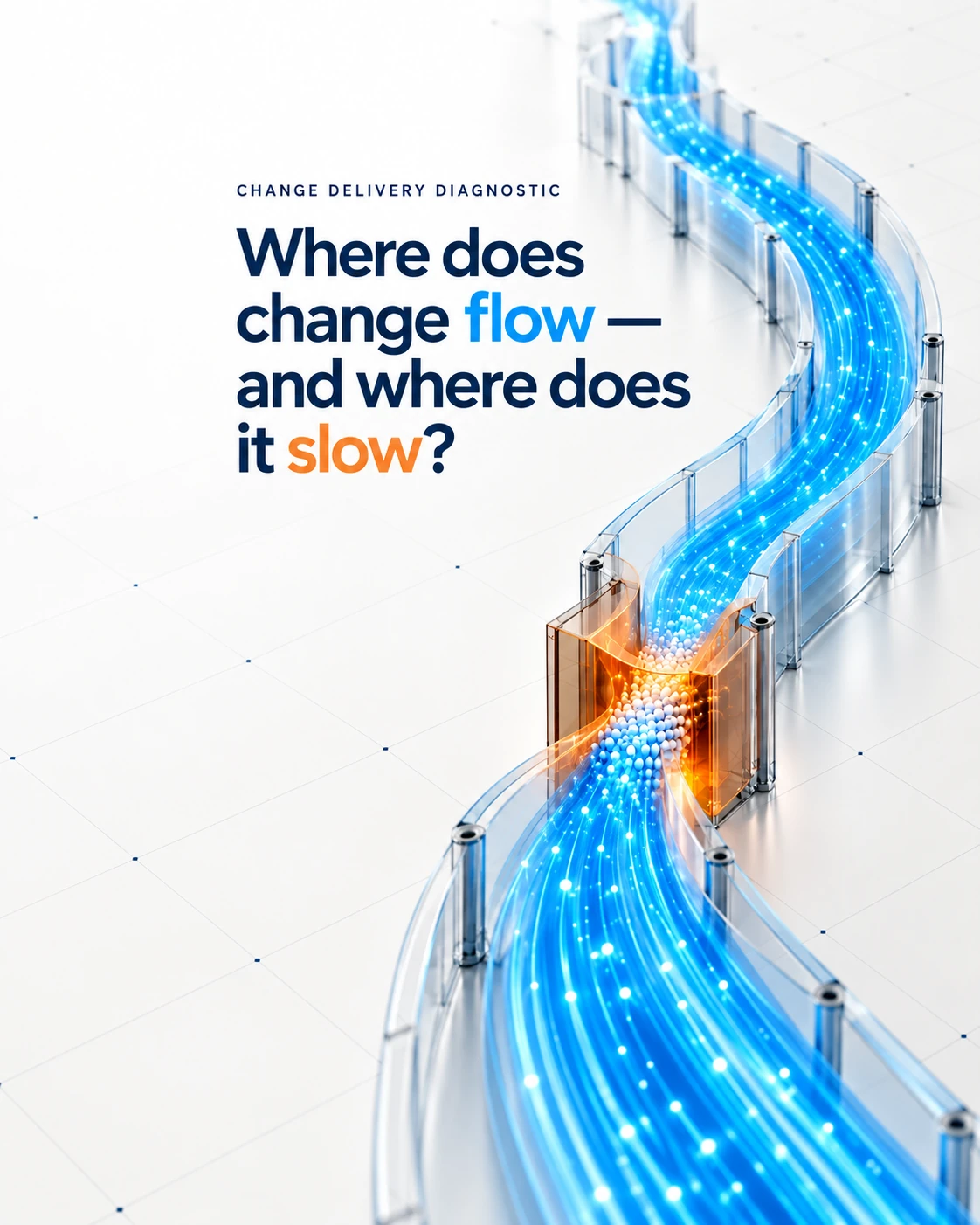
Is the way you deliver fit for a world of continuous change?
Find out where change flows — and where it slows.