How does Product Engineering reduce Product-to-Engineering hand-offs?
Product Engineering reduces Product-to-Engineering hand-offs by involving Engineering while problems and options are still being understood. Product retains accountability for value and priority; Engineering retains accountability for technical approach and sizing. Shared shaping, accessible evidence and continuing decisions reduce the need to transfer a complete specification between separate groups.
Key takeaways
- A hand-off is harmful when context and decisions are transferred one way between separate groups.
- Shared shaping lets Product and Engineering build understanding before commitment.
- Artefacts should preserve decisions and evidence, not substitute for conversation.
- Clear accountabilities and continuous access matter more than adding ceremonies.
Product-to-Engineering hand-offs can look efficient. Product prepares the work, Engineering builds it, and each group stays focused on its specialism. In practice, the boundary often delays questions until the proposed solution is expensive to change.
Product Engineering reduces this loss of context without asking everyone to do the same job. It changes the flow of information and decisions so Product and Engineering contribute at the points where their expertise matters.
The problem is the transfer of context, not every transition
Work always moves between activities and people. A designer may complete a prototype before an engineer implements it; an engineer may pass a change into operational support. These transitions are not automatically harmful.
A damaging hand-off occurs when one group completes its part in isolation and transfers an output to another group with limited access to the reasoning behind it. The receiving group is expected to accept decisions already made. Questions travel back through documents, tickets and meetings, increasing delay and misunderstanding.
In a Product-to-Engineering hand-off, Engineering may receive detailed requirements without direct knowledge of the user evidence, desired outcome or negotiable boundaries. Product may receive an estimate without understanding the approach, assumptions or technical risks behind it.
Traditional controls can preserve the separation
Templates, acceptance criteria, approval gates and definitions of ready can improve clarity. They are valuable when they record material decisions, meet governance needs or help distributed teams coordinate.
They become counterproductive when completeness is used to prevent conversation. Product may spend substantial effort predicting every technical question, while Engineering waits for a perfect input. Review then becomes an acceptance gate rather than joint shaping.
Adding more refinement meetings does not by itself remove the hand-off. If Product presents a finished solution and Engineering only confirms its estimate, the decision flow remains one way.
Build shared understanding before and during delivery
Product Engineering brings relevant Engineering input into problem understanding and solution shaping. Product explains the customer and business problem, outcome, evidence and priority. Engineering explores feasibility, alternatives, dependencies, risk and size. Design, Research, Data, Security and Operations join where their knowledge affects the decision.
The Agile Manifesto's principles call for business people and developers to work together throughout delivery. Scrum guidance similarly treats backlog items as emerging through continuing refinement and recommends Product Owner, Developer and stakeholder discussion to create shared understanding.
Useful practices include:
- Regular access to upcoming problems rather than batches of finished Features
- Joint review of customer, product and operational evidence
- Short shaping sessions around options and trade-offs
- Direct questions between Product and Engineering
- Decision records that capture intent, assumptions and boundaries
- Continued Product availability during delivery
- Joint review of outcomes and system behaviour after release
The aim is not to eliminate documentation. A concise Feature record can make collaboration durable across time zones and staff changes. It should capture what the team has learned rather than act as a contract between functions.
Preserve accountability while shortening feedback loops
Reducing hand-offs can fail if every decision becomes a group decision. Product still owns the What and Why, including value and priority. Engineering owns the How and How Much, including technical integrity and sizing. Named ownership lets the team collaborate quickly without waiting for consensus on matters with a clear accountable role.
Use proportionate participation. The whole team need not join every early conversation, but the right Engineering knowledge must be available before commitments close down the options. Create escalation routes for trade-offs involving both product value and technical risk.
Measure whether the flow improves. Signals can include fewer late clarifications, less rework caused by misunderstood intent, earlier discovery of dependencies, shorter time from problem selection to a credible decision, and stronger understanding across the team. Do not assume that fewer documents or meetings proves success.
AI may make requirements and code faster to produce, which can increase the volume crossing a weak boundary. Use it to support shared evidence, option exploration or documentation, while keeping humans accountable for context and decisions.
Example
A Product team previously wrote complete Features for a claims platform and submitted them to Engineering for estimates. Integration questions regularly appeared after roadmap commitments.
The team introduces a weekly shaping conversation for the highest-priority problems. Product shares evidence and intended outcomes; an engineer and designer explore options and record key assumptions. Specialists join only when needed. Features reach estimation with fewer hidden dependencies, while Product and Engineering retain their separate value and technical accountabilities.
FAQs
-
Does reducing hand-offs mean removing documentation?
No. Documentation should preserve shared understanding, decisions, evidence and constraints. The problem arises when a document replaces access to the people and reasoning needed to interpret or change it.
-
Does everyone need to attend every shaping session?
No. Include the people whose knowledge can materially affect the current decision. Maintain ways for the wider team to access the context and raise questions, and bring in specialists when risk or complexity requires them.
-
How can distributed teams reduce hand-offs?
Use concise decision records, shared evidence, recorded walkthroughs and defined response routes alongside scheduled overlap for important shaping. Asynchronous tools should extend collaboration rather than turn Features back into one-way instructions.
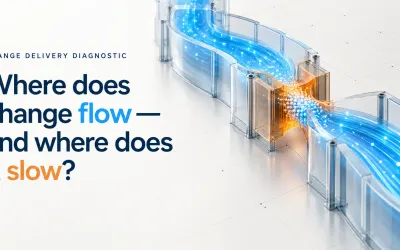
Is the way you deliver fit for a world of continuous change?
Find out where change flows — and where it slows.