How does AI change the role of Product in Product Engineering?
AI can give Product faster ways to explore information, develop options and work with engineering artefacts, but it does not transfer Engineering accountability to Product. Product remains accountable for the What and Why: the problem, value, outcome and priority. Its role grows in shaping clear intent and orchestrating AI-enabled capacity with Engineering, not independently accepting technical risk.
Key takeaways
- Product remains accountable for the problem, value and intended outcome.
- AI can shorten exploration and feedback but does not validate customer need.
- Product and Engineering should choose the delivery model together.
- More delivery capacity makes prioritisation and outcome discipline more important.
As AI tools make prototypes and code easier to generate, Product people may become more directly involved in creating working artefacts. That can improve shared understanding. It can also blur the boundary between exploring an idea and accepting a production-ready technical solution.
Strong Product Engineering uses the new capability to deepen collaboration. It does not replace the What and Why, or make Product solely responsible for the How and How Much.
Product ownership remains centred on value
Product still identifies the customer or business problem, clarifies the desired outcome, sets priority and decides whether a Feature is worth pursuing. AI can summarise research, organise evidence or suggest options, but it cannot own the organisation's strategy, customer relationships or trade-offs.
Product people must test generated interpretations against source evidence and real users. Fluent output can make a weak assumption appear settled. Keep the distinction between observed evidence, an AI-generated synthesis and a Product decision visible.
Faster creation does not remove prioritisation. If ideas and prototypes multiply, Product must protect focus and avoid turning inexpensive generation into unnecessary product complexity.
Product can work with richer options earlier
AI can help Product draft scenarios, explore edge cases, create low-fidelity prototypes, query technical documentation and prepare clearer acceptance context. These uses can make early conversations with Engineering more concrete and expose uncertainty sooner.
The artefact is a conversation aid, not a specification that Engineering simply implements. Product should explain the problem, constraints and assumptions, while Engineering assesses architecture, security, integration, operability and effort. Both refine the Feature through Understand, Shape, Estimate, Deliver and Learn.
Where Product uses AI directly, it should follow approved data and tool boundaries. Customer records, confidential strategy and production access remain governed regardless of who operates the tool.
Product helps choose and orchestrate delivery capacity
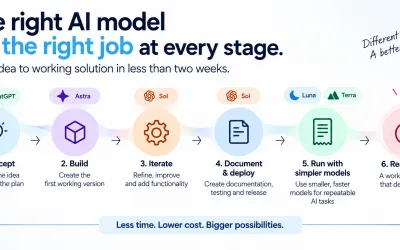
Product and Engineering can decide whether work is human-led, AI-assisted or more agent-enabled. Product contributes knowledge of value, ambiguity and customer consequence. Engineering contributes technical complexity, feedback quality, risk and the amount of judgement required.
For bounded, lower-risk work, Product may direct more of the intent while an approved AI capability prepares artefacts for Engineering acceptance. Complex or sensitive work continues to need substantial human Engineering leadership. These are contextual delivery choices, not new job titles or maturity levels.
Product should make acceptance criteria and prohibited outcomes explicit. It must not interpret passing tests or a convincing demonstration as proof that the Feature is valuable or ready.
Product measures outcomes rather than generated activity
As AI increases potential throughput, Product should watch whether the team solves more valuable problems, learns faster and improves customer outcomes. Generated Features, prompts or lines of code are activity measures and may reward excess work.
Include downstream evidence: adoption, support demand, defects, rework, maintainability and the human effort needed to supervise delivery. Work with Engineering to decide whether increased capacity is sustainable or simply moving effort into review and operation.
Product capability therefore shifts towards clearer intent, faster evidence use, option evaluation and responsible orchestration. It remains grounded in judgement and accountability. The role is strengthened when AI creates better conversations and learning, and weakened when generation is allowed to substitute for discovery or decisions.
Example
A Product Owner uses an approved assistant to turn interview notes into themes and create two prototype flows. She checks every theme against the original research and marks uncertain interpretations. Engineering reviews the flows early and identifies an authentication constraint.
The team uses AI to prepare a bounded prototype but keeps production design human-led. Product decides which customer outcome matters; Engineering owns the technical approach and acceptance. The prototype accelerates shaping without silently transferring architecture responsibility to Product.
FAQs
-
Will Product Managers need to become software engineers?
They need greater technical fluency to make informed delivery choices, but not to assume Engineering accountability. Role depth and local expectations will still vary.
-
Can Product use AI to define a Feature without Engineering?
Product can explore and clarify the problem, but Engineering should become involved before technical assumptions harden, especially where architecture, integration, security or sizing matters.
-
Does faster AI delivery mean Product should manage a larger backlog?
No. A larger backlog is not evidence of value. Product should maintain focus, remove weak ideas and measure whether delivered work improves intended outcomes.

What comes after Product Engineering?
Talk to us about adding AI to help your teams deliver more, move faster and reduce reliance on extra headcount.