How do you introduce Product Engineering into an existing organisation?
Introduce Product Engineering as a change to decisions, team conditions and learning rather than a reorganisation or new label. Start with a real product area, diagnose the constraints around it, give a cross-functional team a clear outcome and decision rights, then improve the surrounding funding, governance and measures using evidence from the work.
Key takeaways
- Begin with a product and customer problem, not a company-wide process rollout.
- Diagnose incentives, dependencies, governance and skills before changing team names.
- Create one supported cross-functional team with clear outcomes and accountabilities.
- Scale only after evidence shows which changes help in your context.
Existing organisations cannot adopt Product Engineering by declaring that project teams are now product teams. Established funding, approval, architecture, supplier and performance systems continue to shape behaviour. If those conditions reward fixed scope and local output, people will reproduce the old model under new terminology.
A safer introduction is an evidence-led organisational change. It connects a real product problem to a deliberately designed team environment, learns where the wider system obstructs progress, and expands only what proves useful.
Establish the reason and diagnose the current system
State what the organisation needs to improve. It might be slow learning, costly hand-offs, weak customer outcomes, unreliable delivery or limited ownership after release. “Become product-led” is too broad to guide decisions or establish whether the change worked.
Map how an idea currently becomes a live change and what happens afterwards. Look at who controls priority, budget, solution approval, technical decisions and release. Examine where teams wait, where context is lost, how dependencies are managed and which measures influence leaders. Speak to Product, Engineering, Design, Operations, Risk and customers rather than relying only on the documented process.
This diagnosis reveals whether the main obstacle is team capability or the environment around the team. Training people in discovery will have limited effect if annual funding has already fixed the scope. Asking engineers to own outcomes will ring hollow if they cannot access customers or production evidence.
Choose a bounded starting point and create the conditions
Select a meaningful product area with a real user need, an engaged sponsor and enough scope to make decisions. Avoid both an inconsequential experiment and the organisation's most politically or technically entangled programme. Define the outcome, boundaries, important controls and the evidence that will be reviewed.
Form a durable, multidisciplinary team around that product or service. Ensure it can access Product, Engineering, Design and the operational or specialist knowledge its risks require. Clarify that Product owns value and priority, Engineering owns technical integrity and sizing, and other disciplines retain their relevant accountability.
Give the team practical access to users, data, environments and decision-makers. Protect capacity for discovery, technical health and measurement. Agree how funding and governance will handle learning without demanding false certainty about every Feature in advance.
Change the work through supported practice
Start with a small number of behaviours: frame problems and outcomes, involve Engineering before solution commitment, compare options, deliver coherent increments and review evidence after release. Coaches or experienced practitioners can work alongside the team, but accountability should remain with the people doing the work.
Leaders must change their own questions. Ask what was learned, which uncertainty was reduced, what outcome moved and what decision follows. Continue to ask about delivery and risk, but do not make output volume the sole definition of progress. Remove obstacles the team cannot resolve, particularly cross-team dependencies and approval delays.
Expect tension. Product may fear losing authority; Engineering may hear “product engineer” as an expectation that every engineer becomes a Product Manager; governance teams may worry that adaptation removes control. Address these concerns explicitly. Product Engineering combines perspectives while retaining professional responsibility and proportionate controls.
Evaluate, adapt and expand the enabling system
Review both outcomes and operating conditions. Is the team learning sooner? Are decisions being made by the right people? Are hand-offs, waiting and avoidable rework reducing? Are reliability and technical flexibility improving or being consumed? Use a mixture of quantitative measures, qualitative evidence and concrete decision examples.
Some constraints will sit beyond the first team. Portfolio commitments, procurement, role expectations, architecture ownership and reward systems may need to change. Treat these as part of adoption, not as unfortunate exceptions the team should work around forever.
Scale through principles, enabling services and communities of practice rather than copying every ceremony. A second product area may need different specialist roles or controls. AI can help analyse feedback, document experiments or reduce repetitive work, but introducing AI tools is not the same as introducing Product Engineering. Expand the model when evidence shows it improves decisions and outcomes without weakening technical or organisational health.
Example
An insurer wants to reduce the time customers wait for a claim decision. Its existing programme passes approved requirements through several specialist teams. Leaders select one common claim type, create a team with Product, Engineering, Design, Operations and compliance access, and define customer waiting time and decision quality as outcomes.
The team discovers that an approval queue, not software construction, causes much of the delay. It tests a new rule and a small workflow change, measures exceptions and reliability, and shortens the feedback cycle. Leadership then changes the relevant governance threshold and uses the evidence to select a second claim journey, rather than announcing a company-wide squad template.
FAQs
-
Do we need to reorganise before starting Product Engineering?
Usually not. Begin by changing the conditions around a bounded product problem. Structural changes may become necessary when reporting lines, funding or dependencies repeatedly prevent ownership, but a large reorganisation without behavioural evidence can reproduce the same constraints.
-
How long does Product Engineering adoption take?
There is no universal duration. A team can change some practices quickly, while funding, governance, architecture and capability may take much longer. Define staged outcomes and review evidence rather than treating adoption as a one-off launch.
-
Should every team adopt the same model?
Teams should share clear principles and organisational controls, but their composition and practices should reflect product risk, maturity and dependencies. Consistency is useful when it reduces friction; it is harmful when it becomes compliance with ceremonies.
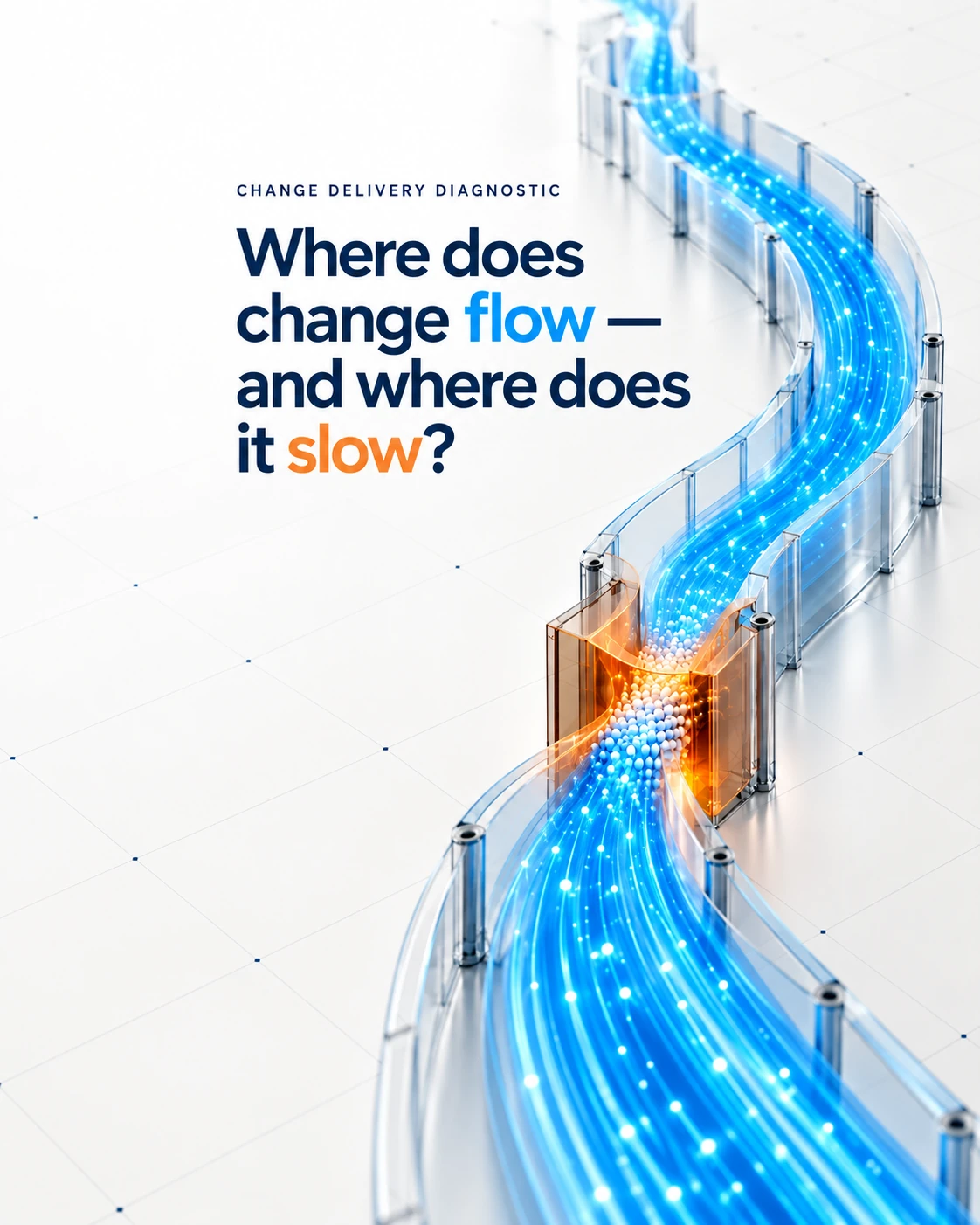
Is the way you deliver fit for a world of continuous change?
Find out where change flows — and where it slows.