How can organisations retain Product and Engineering knowledge as AI does more delivery work?
Organisations retain Product and Engineering knowledge by keeping decisions, context and operational learning in owned, reviewable sources and ensuring people remain directly involved in delivery. AI can retrieve and draft knowledge, but its conversation history is not organisational memory. Teams need clear ownership, durable records, hands-on practice and regular validation against the product and system.
Key takeaways
- Keep authoritative knowledge outside individual AI sessions and vendor tools.
- Record decisions and rationale, not every generated interaction.
- Preserve direct human engagement with customers, code and operation.
- Test whether knowledge can be found, understood and challenged by others.
AI can make it easier to navigate a codebase or summarise a product decision. It can also create an illusion that knowledge has been captured because a tool can answer a question. Its answer may rely on stale context, inaccessible chat history or patterns nobody has validated.
Organisational knowledge is retained when responsible people can find, understand, challenge and update it. As more work is delegated, teams must design that retention rather than assume generated artefacts provide it.
Identify the knowledge that must endure
Product knowledge includes customer needs, business rules, priorities, outcome evidence and rejected options. Engineering knowledge includes architecture, interfaces, constraints, operational behaviour, security decisions and recovery experience. Much of the most valuable knowledge is the rationale connecting a decision to its context.
Identify critical areas where loss would slow change or increase risk. Name owners and expected review points. Avoid trying to document everything: an indiscriminate archive creates noise and may expose sensitive data without helping future decisions.
AI-generated work should leave enough provenance to connect an accepted change with its task, evidence and responsible decision.
Maintain authoritative sources near the work
Use appropriate durable records such as product evidence repositories, architecture decision records, code, tests, runbooks and incident reviews. Make clear which source is authoritative when an AI answer or generated document conflicts with it.
Keep records concise and current. Store significant context in organisation-controlled systems rather than relying on one person's prompts or a provider's conversation history. Apply access, retention and security controls because documentation and transcripts can contain source code, vulnerabilities or customer information.
AI can draft summaries and identify missing links, but a named person should validate material knowledge before it becomes authoritative.
Keep people in the learning loop
People build understanding by shaping, implementing, reviewing, debugging and operating systems. If they only approve polished summaries, they may lose the mental models needed to recognise a plausible mistake. Preserve rotations, pairing, design discussion, incident participation and direct customer contact.
Use AI to support explanation without allowing it to become the sole teacher. Ask engineers and Product people to explain decisions in their own words, trace evidence and test assumptions. Distribute expertise so critical knowledge does not move from one human bottleneck into one tool-dependent bottleneck.
Early-career staff need deliberately scoped work where they can reason and receive feedback, even if an agent could complete it faster.
Test and refresh organisational memory
Review knowledge after material changes, incidents and repeated AI errors. Check whether a person unfamiliar with the work can locate the current decision, understand why it exists and identify its owner. Broken links, conflicting instructions and unexplained exceptions are useful signals.
Monitor whether teams increasingly depend on one model, provider or specialist to interpret their own systems. Practise operating when the AI service is unavailable and retain export or migration routes for important records.
Retire obsolete guidance and record supersession so agents and people do not imitate old patterns. Knowledge retention is not the volume of stored text. It is the organisation's continuing ability to make sound Product and Engineering decisions as people, products, systems and tools change.
Example
An agent implements routine changes to a pricing service. Each accepted change links to the Feature intent, an architecture decision where relevant, tests and the reviewing engineer. Product rules stay in an owned domain record rather than inside agent prompts.
During a service review, a new engineer finds two conflicting retry instructions. The team resolves the source, marks the old decision as superseded and updates the repository guidance. The agent helps locate references, while people own the corrected knowledge.
FAQs
-
Should organisations save every AI conversation?
Not by default. Retain evidence needed for delivery, audit and learning, while minimising sensitive or low-value data. Move material decisions into authoritative records.
-
Can a codebase be its own documentation?
Code and tests are important sources, but they may not explain product intent, rejected options or operational trade-offs. Record rationale where future decisions depend on it.
-
How can teams detect overdependence on AI?
Check whether people can explain, diagnose and operate systems without the tool, and whether authoritative knowledge remains accessible if a service or provider changes.
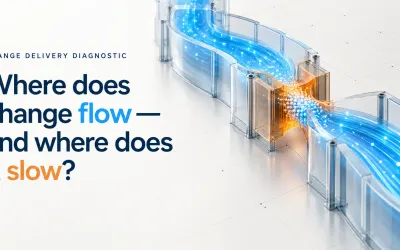
Is the way you deliver fit for a world of continuous change?
Find out where change flows — and where it slows.