How can AI support Product and Engineering discovery and Feature shaping?
AI can help Product and Engineering organise evidence, explore questions, identify assumptions and compare solution options during discovery and Feature shaping. It should accelerate shared understanding rather than manufacture certainty. Product remains accountable for the problem and value, Engineering for technical implications, and both must verify AI-generated interpretations against customers, source evidence and the real system.
Key takeaways
- Use AI to extend exploration, not replace customer or engineering evidence.
- Keep source material and generated interpretations visibly separate.
- Involve Product and Engineering together when prompts shape delivery decisions.
- Record assumptions and uncertainty rather than polishing them away.
Discovery and shaping involve large amounts of incomplete information: research notes, support themes, product data, technical constraints and competing ideas. AI can make this material easier to explore, but fluent summaries may hide weak evidence or merge distinct customer needs.
The useful role is to help the team ask better questions and reach shared understanding sooner. Decisions still belong to the people accountable for the product and system.
Begin with the decision being shaped
Define the problem, desired outcome and decision the team needs to make. AI may help cluster research, draft problem statements, identify missing questions or create alternative scenarios. Without a clear decision, it tends to produce broad lists that look comprehensive but add little value.
Choose source material deliberately. Confirm that customer data, commercial information and technical context are permitted for the tool. Retain links to the originals so people can test a summary or claim. Generated personas, quotations or demand must never be presented as observed evidence.
Product owns the What and Why. AI output can inform that judgement, but cannot establish customer value by itself.
Explore options with Product and Engineering together
Use AI to create questions, edge cases, process variations, low-fidelity prototypes and possible solution approaches. Product can assess value and user consequences while Engineering tests feasibility, architecture, integration, security and effort.
This shared use is stronger than Product generating a polished specification and handing it to Engineering. The team can expose assumptions before they harden and compare options against the same outcome. Engineers may also use AI to explain existing system constraints in accessible language, provided the explanation is checked.
Include a non-AI or simpler operational option where relevant. Generation can make building software appear easier than changing a process or removing unnecessary demand.
Turn exploration into a bounded Feature
Summarise the chosen outcome, scope, exclusions, constraints, dependencies, acceptance evidence and unresolved questions. AI can draft this material from the discussion, but Product and Engineering should review it separately from the generated options that led to it.
Mark confidence and source. Distinguish customer evidence, system facts, team assumptions and AI suggestions. Avoid allowing a model to estimate delivery from a narrative alone; Engineering remains accountable for the How and How Much.
The resulting Feature should contain enough clarity for a decision, not every implementation detail. Preserve space for learning during delivery.
Validate the shaping contribution
Check whether AI reduced effort, improved coverage of questions or revealed options that survived human scrutiny. Also record false themes, invented facts, data concerns, rework and time spent checking. A faster workshop is not useful if it creates downstream confusion.
Use small, reversible experiments where uncertainty remains. Test prototypes with relevant users and technical assumptions against the real environment. Feed accepted learning back into authoritative Product and Engineering records rather than leaving it in a chat.
As capability changes, reassess which activities are dependable. AI can increase the breadth and speed of exploration; it does not remove the need to decide what evidence deserves trust.
Example
A team is shaping improvements to customer onboarding. An approved assistant groups support tickets and proposes failure scenarios, with every theme linked to source records. Product rejects a generated theme that lacks evidence. Engineering uses the scenarios to inspect integration constraints and identifies an existing service the team can reuse.
Together they define a smaller Feature, its expected outcome and two assumptions to test. AI speeds the synthesis, while customer evidence and technical judgement determine the decision.
FAQs
-
Can AI replace customer interviews during discovery?
No. It can help prepare questions and analyse authorised material, but generated responses are not evidence from real customers or their context.
-
Should teams use AI to write acceptance criteria?
AI can draft candidates and edge cases. Product and Engineering must verify that they represent the intended outcome, relevant risks and feasible evidence.
-
Can AI estimate a Feature during shaping?
It may help expose tasks or uncertainty, but Engineering remains accountable for sizing based on the actual system, constraints and delivery environment.
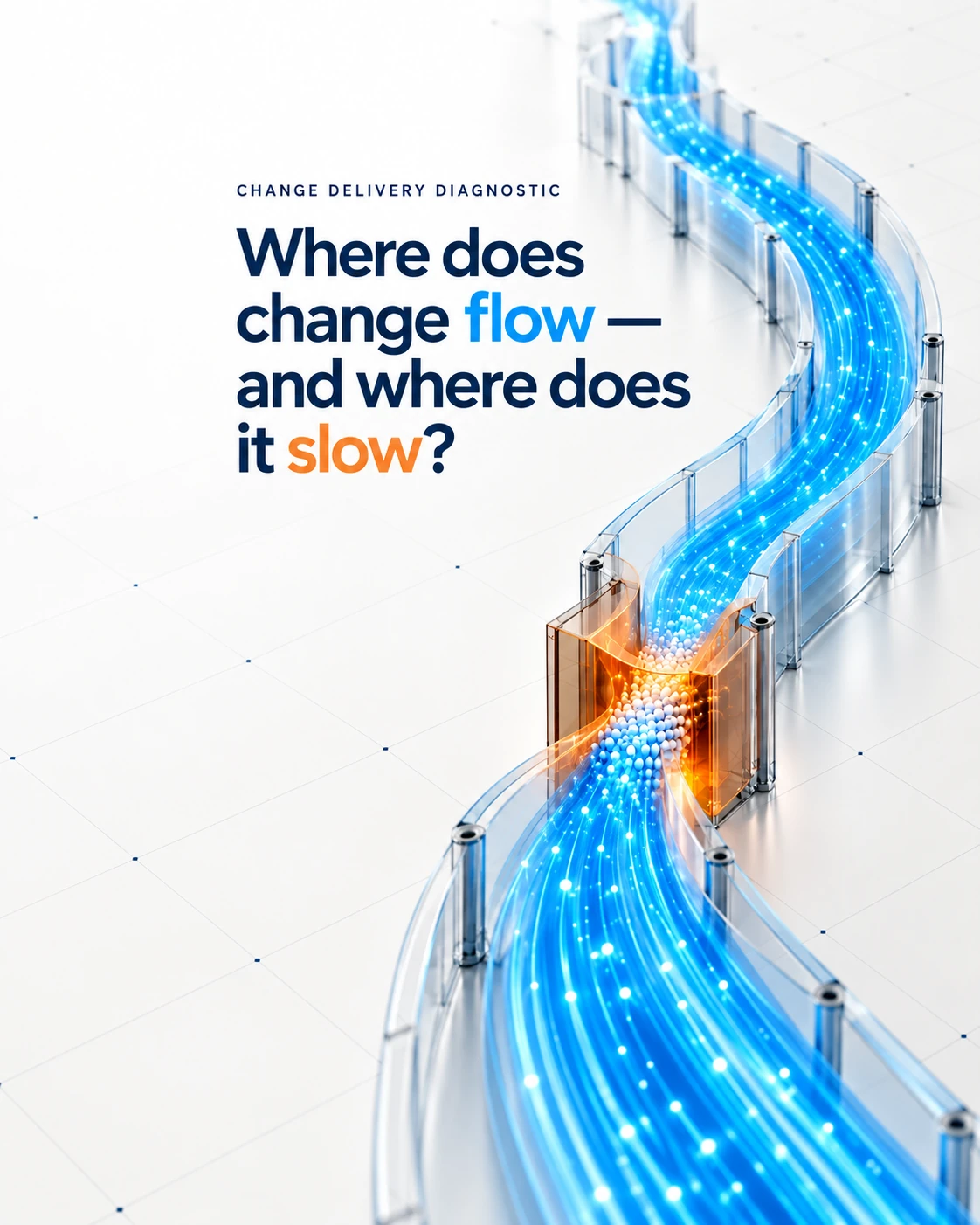
Is the way you deliver fit for a world of continuous change?
Find out where change flows — and where it slows.