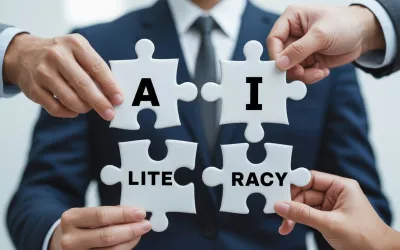
How can people combine domain expertise with AI fluency?
Effective workplace AI use combines domain expertise with practical AI fluency. The professional supplies the context, standards and meaning needed to frame and judge the work; AI fluency helps them direct, test and integrate the tool. Most users do not need to become machine-learning specialists, but confident interaction cannot replace expertise they lack.
Key takeaways
- Natural-language access lowers technical barriers but does not confer professional expertise.
- Domain knowledge improves the context, criteria and challenges applied to AI assistance.
- AI fluency includes directing, testing and integrating the tool, not simply prompting quickly.
- Learning should develop AI and domain capability together around genuine work.
Natural-language AI tools allow professionals to use advanced capabilities without building a model or writing code. That accessibility can make AI seem like a technical subject that has suddenly become easy, or like a general assistant that can supply any missing expertise.
Both interpretations overlook the work itself. An AI response becomes useful only when someone connects it to the right evidence, standards, context and decision.
Most workplace users need practical AI fluency rather than specialist machine-learning ability. They also need the domain expertise that gives the interaction professional meaning.
Accessible AI changes who can use advanced capabilities
Earlier data and AI systems often required specialist technical teams to build queries, models or applications. Natural-language interfaces lower parts of that barrier. A claims professional can ask for a comparison, a product manager can organise research notes and a technical leader can explore an architecture option.
This does not eliminate technical work. Specialists still need deeper capability to develop, configure, test and govern systems. The change is that many domain professionals can now apply AI directly within their own workflows.
Practical AI fluency for those users includes recognising a suitable task, communicating goals and context, using approved features, evaluating responses, iterating and integrating useful work. These are interaction and workflow skills rather than model-building expertise.
Technical confidence cannot supply missing domain knowledge
A person may become fast and confident with an AI interface. They can produce polished material and know several effective prompting techniques. That fluency does not give them the knowledge to judge every subject the tool can discuss.
Domain expertise identifies what matters. It distinguishes an immaterial wording change from a coverage issue, a plausible metric from the one used in a decision, or syntactically correct code from a design that conflicts with operational constraints.
AI can help someone explore outside their domain, especially in low-consequence learning. The risk appears when they rely on a result they cannot evaluate. Fluent interaction can conceal this limit because both the request and response sound sophisticated.
The appropriate response may be to seek a specialist, narrow the use or stop. Recognising the edge of one's expertise is part of capability.
Use expertise before, during and after the AI interaction
Domain expertise contributes throughout the workflow.
Before using AI, it helps the professional frame the right outcome, select authoritative sources and identify constraints. During the interaction, it supplies relevant terminology, exceptions and context that a generic request would omit. When the response arrives, it provides the quality criteria needed to challenge and interpret it.
Afterwards, expertise determines how the work can be applied. A useful draft may need adaptation to a customer, operating environment or professional standard. A correct observation may not justify the proposed action.
Learning should make these contributions visible. Ask the learner to explain which domain assumptions they supplied, which criteria they used and which part required another person's expertise. This prevents assessment from rewarding prompt fluency alone.
AI fluency contributes in the other direction. It helps a domain expert translate tacit knowledge into explicit context, test alternatives efficiently and understand the system's limitations through controlled use.
Build both capabilities without hollowing out the core
Use role-relevant scenarios that require both kinds of skill. The learner should direct an approved tool and apply professional evidence, standards and judgement. Feedback may need both a facilitator who understands AI interaction and a domain mentor who can challenge the content.
Protect unaided capability where the role still depends on it. If a professional always delegates a core reasoning step, they may lose opportunities to practise the expertise needed to evaluate future outputs. Some learning activities should ask them to form an initial view or quality bar before seeing AI assistance.
Different roles need different balances. A general user may need foundational literacy and strong escalation habits. A technical specialist may need deep system knowledge. A regulated professional may need explicit evidence and oversight practice.
This is why AI learning should not be reduced to technical training or a list of human qualities. Effective use combines technology fluency with the expertise of real work. Individuals can develop that combination through relevant practice, mentoring, feedback and deliberate attention to the parts of their professional capability that AI should augment rather than replace.
Example
An underwriter learns to use an approved assistant to compare information across a hypothetical policy file. Their insurance knowledge helps them specify material terms, recognise an omitted condition and question an unsupported coverage interpretation.
The learning activity also develops AI fluency. The underwriter provides structured context, requests source traceability and separates factual comparison from the decision that requires senior review.
A senior underwriting mentor and facilitator give feedback on both dimensions. AI interaction skill augments the professional practice without presenting the tool as a substitute for insurance expertise.
FAQs
-
Do effective AI users need technical skills?
Most workplace users need practical literacy in using, evaluating and integrating approved AI tools. Specialist roles need deeper skills in development, data, testing or governance. The right depth depends on the work and responsibility.
-
Can AI help someone work outside their domain expertise?
It can support bounded exploration, explanation and low-consequence learning. Do not rely on an output when you cannot evaluate its evidence or implications. Seek relevant expertise, narrow the task or avoid the use.
-
Could using AI weaken domain expertise over time?
Passive delegation can remove opportunities to practise core reasoning. Stay actively involved, form independent criteria where appropriate, use mentoring and preserve unaided practice for capabilities the role still needs.
AI Learning for Insurance Teams
AI learning modules designed for speciality insurance teams that deliver measurable value in the underwriting room, claims desk and delegated authority function.