How can collaborative AI games strengthen peer learning?
Collaborative AI games can strengthen peer learning by making people's choices, assumptions and strategies visible around a shared challenge. Interdependent roles and structured debriefing let participants compare how others framed, tested and judged AI assistance. Simply placing learners in teams is insufficient; participation, psychological safety and facilitator skill determine whether different approaches become useful learning.
Key takeaways
- Interdependent roles reveal knowledge and decisions that one learner may overlook.
- Comparing reasoning is more useful than comparing final scores alone.
- Structured participation reduces the risk that confident tool users dominate the activity.
- Debriefing turns local tactics into qualified, shareable learning.
AI use can be surprisingly private. One person writes the request, sees the intermediate responses and makes corrections. Colleagues receive the final output without seeing how the work was framed or judged.
This hides useful differences. A domain expert may notice a missing assumption, a frequent AI user may know how to restructure the interaction and a risk colleague may identify an escalation point.
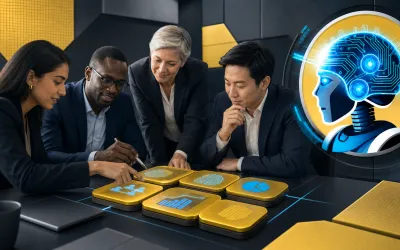
A collaborative game can bring those perspectives into one visible challenge. Peer learning emerges only when the activity requires genuine interdependence and makes room to examine the reasoning afterwards.
Collaborative play can expose hidden AI working practices
Two people can reach similar outputs through very different processes. One checks sources before prompting. Another generates broadly and verifies afterwards. A third changes the task when the first result is weak.
In ordinary work, those choices may remain invisible. A shared challenge gives participants a reason to explain them. The game can distribute information, authority or resources so that no one person holds the complete picture.
This is particularly useful for AI capability because effective use combines several perspectives: work context, tool interaction, output evaluation and professional judgement. Interdependent roles allow learners to contribute what they know and observe what they usually overlook.
The game supplies a common event for discussion. Learners are not debating an abstract best practice; they can point to a choice, consequence and alternative.
A team and a leaderboard do not guarantee peer learning
Putting four people at one table may still produce individual learning for only one person. A confident AI user can take control of the tool while others watch. A senior colleague can define the strategy before quieter participants contribute.
Competition can reinforce this pattern. If speed and score dominate, teams may divide work for efficiency rather than share reasoning. They may conceal uncertainty from rival teams or copy a tactic without understanding its conditions.
Social loafing is another risk. Vague group roles allow some participants to remain passive. Decorative labels do not create interdependence if everyone has the same information and one person can solve the challenge alone.
Collaborative learning requires structure. The design should make contributions necessary, visible and discussable without turning the activity into a public assessment of individual competence.
Design interdependence and visible reasoning
Give each role distinct information, expertise or decision authority. One participant might frame the task, another direct the AI, another verify evidence and another decide whether the result can progress. The roles should reflect real contributions rather than stereotypes.
Rotate roles in another round so that learners experience a different perspective. Allow individual thinking time before group discussion and use written rationales or choice cards so the first confident voice does not determine every decision.
Make the team capture important choices: what it asked the AI to do, what evidence it relied on, what it rejected and why. These records matter more for peer learning than a final score.
Consider a cooperative format in which teams work against the scenario or share discoveries. Limited competition can create energy, but it should never require withholding learning that the activity is meant to surface.
Use the debrief to compare and qualify approaches
The debrief converts several team experiences into shared knowledge. Ask what each group tried, what it expected and what evidence changed its view. Compare processes before revealing scores or facilitator observations.
Invite participants who held different roles to describe what they noticed. A facilitator can surface the tension between speed and checking, or between broad exploration and controlled data use, without declaring that one balance is always correct.
Qualify the lesson. A technique may have worked because the source was structured, the task was low consequence or the facilitator provided a cue. Record those conditions alongside the practice so peers do not turn it into an untested universal rule.
Psychological safety is central. Discuss the strategy rather than blaming the person. Treat uncertainty and failed attempts as material for collective inquiry.
Collaborative games do not replace communities of practice or everyday peer support. They create a concentrated opportunity to expose different approaches and build a shared language that those ongoing structures can continue to develop.
Example
A technical leadership group plays a challenge about a fictional delivery risk. One participant frames the problem, another directs an approved AI assistant, a third checks technical evidence and a fourth decides whether to escalate.
Roles rotate in a second round with a different constraint. Teams discover that a strong prompt cannot compensate for an unclear quality bar, and that an early architecture check changes the useful role for AI.
The facilitator compares where each allocation exposed or concealed assumptions. Participants learn the reasoning behind alternative working practices instead of copying one winning prompt.
FAQs
-
Should collaborative learning games be competitive?
They can be, but competition should serve the learning objective. Cooperative or team-against-scenario formats are often better when people need to share uncertainty and techniques. Avoid incentives to hide useful evidence or let speed dominate judgement.
-
How can quieter learners contribute?
Use meaningful rotating roles, individual thinking time, written choices, small groups and direct but supportive facilitator invitations. Do not assume that visible tool operation is the only valuable contribution.
-
Is the debrief more important than the game?
They have complementary roles. The game creates choices and shared experience; the debrief helps learners interpret causes, compare strategies and qualify what should transfer. Either part can be weak if the other is poorly designed.

AI in Action
Generate your own horse race. You supply the names, AI genereates the commentary and a unique winner!