What constrains engineering capacity?
Engineering capacity is constrained wherever valuable work repeatedly waits, fails, returns for correction or depends on scarce knowledge. Common constraints include excessive work in progress, slow decisions, dependencies, weak development environments and technical debt. Diagnose the flow of real work before deciding that the team needs more people.
Key takeaways
- The limiting constraint may sit outside the engineering team.
- Busy people and full backlogs can conceal slow end-to-end flow.
- Technical friction, knowledge concentration and operational interruptions consume capacity.
- Improve the dominant constraint, then reassess because the bottleneck will move.
When delivery feels slow, visible coding time attracts attention. Yet a Feature may spend far more time waiting for a decision, environment, review or dependency than being actively developed. Asking engineers to work faster does little to change that elapsed time.
Capacity diagnosis follows the work across its whole path. It looks for the condition that most limits safe progress towards the intended outcome, including conditions created by product planning, governance and organisation design.
Too much demand creates queues and divided attention
When more work enters a system than it can complete, queues grow. Teams start several Features to keep people occupied, then switch context as each item encounters a blocker. Progress is spread thinly, feedback arrives later and ageing work becomes harder to understand.
Unclear or frequently changing priorities create similar friction. Engineers may discard analysis, repeat shaping or keep partially completed work alive “just in case”. A large backlog can give the appearance of control while obscuring which outcomes genuinely matter.
Examine work in progress, item age, blocked time and the rate at which work is started versus finished. Limiting concurrent work is not about making people idle. It concentrates the team's effort, exposes the next constraint and creates room to respond to variation.
Decisions, dependencies and specialist access limit flow
Teams lose capacity when they cannot make or obtain timely decisions. Product clarification may arrive after implementation starts. Architecture or security review may occur at the end. Funding boundaries can require approval for small changes. Each queue lengthens the feedback cycle and increases the chance of rework.
Dependencies have the same effect. A team may wait for another product, a supplier, a data owner or a shared environment. If many teams depend on one scarce specialist, that person becomes a routing point rather than an enabling source of expertise.
Map who and what each recent Feature waited for. Bring important expertise into shaping earlier, clarify delegated decision rights and make recurring dependencies visible at the level able to change them. Do not disguise waiting as an estimation failure.
The engineering environment can consume skilled time
Fragile builds, slow tests, inconsistent environments, manual deployments and poor observability turn routine change into expensive work. Technical debt matters when it increases the cost or risk of achieving current outcomes; treating it only as an abstract code-quality concern makes prioritisation difficult.
Operational instability also displaces planned work. Incidents, support requests and repeated manual recovery may show that the product lacks reliability investment. Separating “delivery capacity” from “run capacity” does not remove the shared technical causes.
Measure feedback time, deployment effort, rework, incidents and common sources of friction. Platform capabilities can reduce repeated complexity across teams, but a platform should solve observed user needs for its engineering consumers rather than become another mandatory layer.
Skills, knowledge and organisational conditions shape capacity
A team may lack a capability required by the work, or its knowledge may be concentrated in one person. Recruitment can help, but onboarding takes time and does not repair inaccessible documentation, isolated ownership or a culture that discourages questions. Pairing, review and deliberate knowledge transfer make existing capacity more resilient.
Meetings, fragmented tools, competing reporting demands and persistent interruption also affect the attention available for difficult work. So do low trust and fear of surfacing uncertainty. These conditions are less visible than headcount, but they influence both speed and decision quality.
AI tools may ease some repetitive or well-bounded tasks. They may also add review load, security concerns or inconsistent output when the environment lacks clear standards and automated feedback. Diagnose whether AI removes the current constraint or merely creates more work at its next stage. After any change, trace the flow again: a constraint managed successfully will usually reveal the next one.
Example
A payments team appears short of engineers because only a few changes reach production each month. Mapping recent Features shows that coding finishes quickly, but work waits for access to test data, a shared integration environment and approval from an architect supporting seven teams.
The organisation provides representative test data, makes environments self-service and agrees architectural guardrails that allow routine decisions within the team. Lead time falls without changing team size. A later review reveals that operational alerts are now the largest interruption, giving the team a new improvement target.
FAQs
-
How do you find the biggest engineering constraint?
Trace several representative pieces of work from decision to production. Compare active and waiting time, note rework and interruptions, and ask the team where progress repeatedly depends on something unavailable. Look for a recurring system pattern rather than one unusual delay.
-
Is technical debt always a capacity constraint?
No. It becomes a relevant constraint when it materially increases change cost, risk, incidents or feedback time for the outcomes the team needs to pursue. Describe that consequence rather than relying on the label alone.
-
Can adding engineers reduce capacity temporarily?
Yes. Existing team members need time to recruit, onboard and share context, and additional coordination may be required. That temporary cost may be worthwhile for enduring demand, but it should be included in the decision.
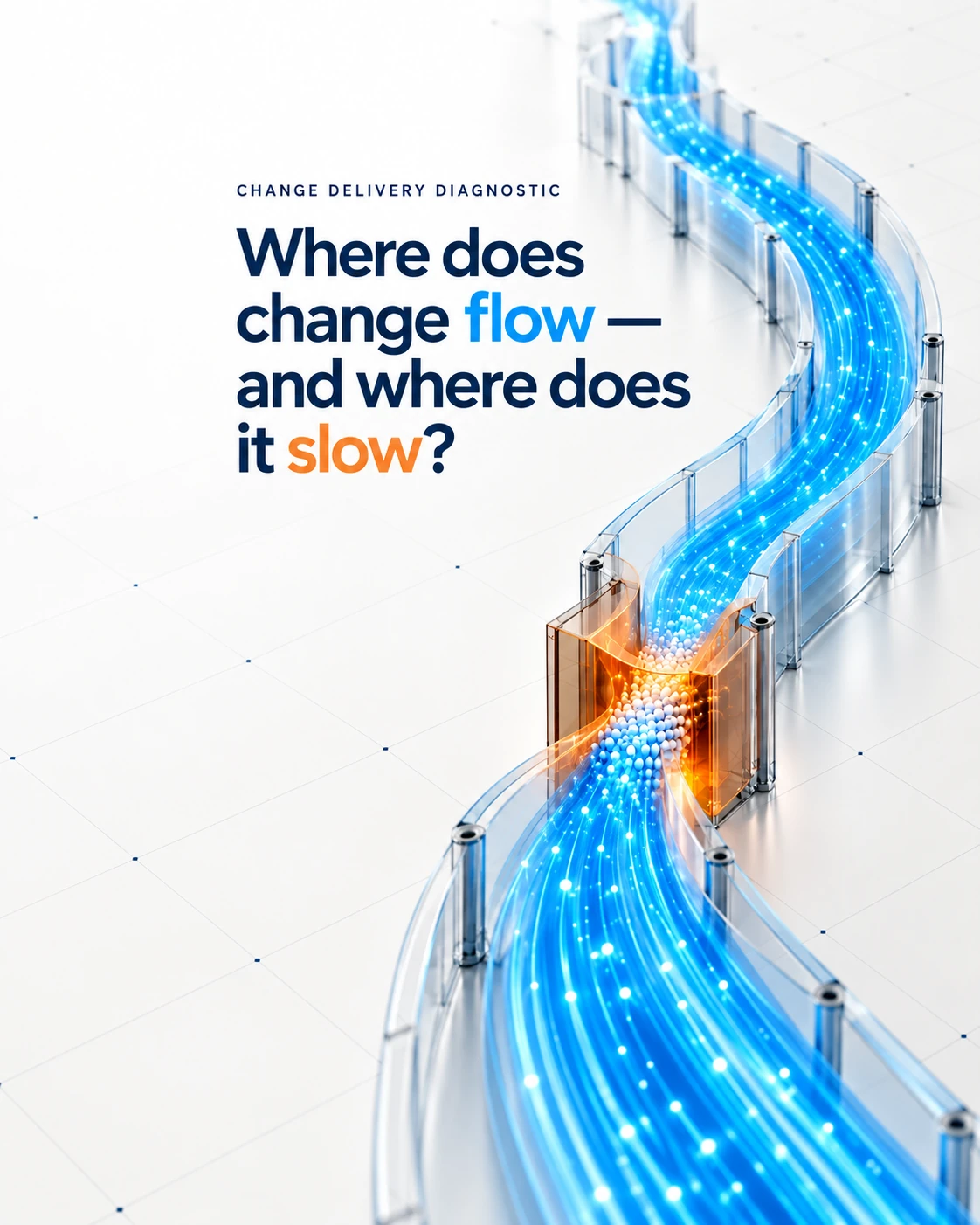
Is the way you deliver fit for a world of continuous change?
Find out where change flows — and where it slows.